
Call us now :08045476828
 Send Inquiry
 Send Inquiry
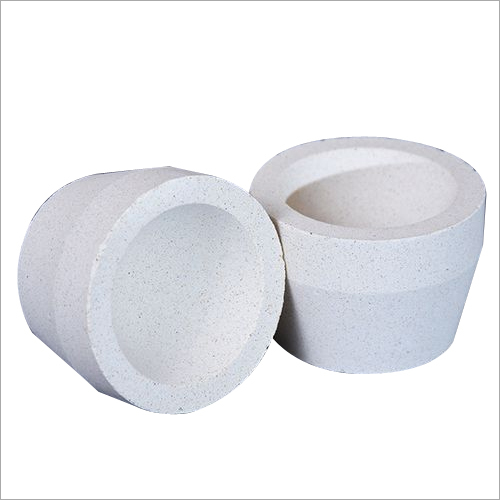
Magnesia Cupels
Price 2500.0 INR/ Metric Ton
MOQ : 1 Metric Ton
Magnesia Cupels Specification
- Chemical Composition
- MgO 98%, SiO2 <1%
- Application
- Gold and Silver Assaying, Fire Assay
- Melting Point
- Above 1600C
- Surface Finish
- Smooth, Non-Glazed
- Usage & Applications
- Quantitative Gold and Silver Analysis, Precious Metal Recovery
- Water Absorption
- <20%
- Purity(%)
- 98 99%
- Form
- Solid, Cup
- Density
- 2.0 Gram per cubic centimeter(g/cm3)
- Hardness (%)
- Approximately 80%
- Product Type
- Fire Assay Cupel
- Types of Refractories
- Basic Refractory
- Shape
- Cup-shaped, Shallow Dish
- Porosity
- Controlled, 28-32%
- Dimensional Stability
- Excellent at High Temperatures
- Strength
- High Compressive Strength
- Specific Gravity
- 2.5 3.05 g/cm
- Thermal Conductivity
- Low
- Color
- White/Grey
- Packing Type
- Corrugated Boxes or Custom Packaging
- Lead Absorption Capacity
- Up to 80% by Weight
- Eco-Friendliness
- Non-Toxic, Crystalline Structure, Environmentally Safe
- Cupel Volume
- Variable, typically 30-50 ml
- Thermal Shock Resistance
- High
- Shelf Life
- 12-18 Months Under Proper Storage Conditions
- Typical Batch Size
- 500 - 1000 Pieces
- Moisture Content
- <1% at Packaging
- Ash Release
- Minimal Ash Production During Assay
- Compatibility
- Suitable for Most Modern Assay Furnaces
- Dimension
- Available in 8g, 10g, 15g, 20g, 30g, 35g, 40g Standard Sizes
Magnesia Cupels Trade Information
- Minimum Order Quantity
- 1 Metric Ton
- Payment Terms
- Cash Advance (CA)
- Supply Ability
- 50 Metric Tons Per Month
- Delivery Time
- 45 Days
- Sample Available
- Yes
- Sample Policy
- Contact us for information regarding our sample policy
- Main Export Market(s)
- Western Europe, Australia, North America, Eastern Europe, Middle East, Central America, South America, Asia, Africa
- Main Domestic Market
- All India
About Magnesia Cupels
We are counted amongst the reputed names of market actively involved in providing a remarkable range of Magnesia Cupels to our customers. These are manufactured from the quality approved materials to ensure their highest strength and durability. Moreover, these Magnesia Cupels are maintenance free and available in a diverse range of specifications as per demands.
Other Detail :
Application : Industrial;,Commercial
Color: Milky White
Material: Magnesia
Mgo Content: 99%
Size: Customize
Superior Fire Assay Performance
Magnesia Cupels provide high accuracy and reliability in quantitative analysis of gold and silver. Their unique crystalline structure and basic refractory nature guarantee minimal ash release and excellent lead absorption, even at extreme temperatures. Controlled porosity enhances separation efficiency while the smooth surface prevents sample loss during the assay process.
Environmentally Safe and Durable
With a composition of 98% MgO and less than 1% SiO2, these cupels are non-toxic, environmentally friendly, and offer low thermal conductivity. Designed for durability, they exhibit high compressive strength and remarkable resistance to thermal shocks, maintaining stability and effectiveness through rigorous usage in assay furnaces.
Consistent Quality and Flexible Sizing
Available in standard sizes ranging from 8g to 40g and variable volumes (3050 ml), each batch is quality-tested for optimal moisture content (<1%) and density (2.0 g/cm). Magnesia Cupels are securely packed in corrugated boxes or custom packaging, ensuring safe transport and a shelf life of 1218 months with proper storage.
FAQs of Magnesia Cupels :
Q: How are magnesia cupels used in gold and silver assaying?
A: Magnesia cupels are primarily used in the fire assay process to separate precious metals (gold and silver) from lead and other impurities. The sample and lead are melted together in the cupel at high temperatures, where the cupel absorbs the lead oxide, leaving behind pure metal beads for analysis.Q: What benefits do magnesia cupels provide over other types?
A: Magnesia cupels offer superior thermal shock resistance, minimal ash production, and high lead absorption (up to 80% by weight). Their high MgO purity (9899%), controlled porosity, and smooth surface also enhance accuracy, reduce contamination, and facilitate easier metal recovery.Q: When should I choose specific dimensions of magnesia cupels?
A: Select the cupel size based on the sample amount and assay requirements. Smaller sizes (8g15g) are used for low-volume or laboratory tests, while larger sizes (20g40g) are preferred for bulk sampling or industrial-scale analyses. The variable volume (3050 ml) accommodates diverse operational needs.Q: Where can magnesia cupels be used?
A: Magnesia cupels are suitable for most modern assay furnaces and are widely used in analytical laboratories, mining companies, precious metal refineries, and research facilities involved in gold and silver analysis and recovery processes.Q: What is the process for using these cupels in a fire assay?
A: In a typical fire assay, the ore sample is mixed with flux and lead, placed in the magnesia cupel, and heated in a furnace above 1000C. As the lead oxidizes, the cupel absorbs the lead oxide, allowing the remaining gold and silver alloy to be collected for quantitative analysis.Q: What precautions should be taken for storage and handling?
A: Store magnesia cupels in a dry environment, away from moisture, as their moisture content should remain below 1%. Proper packaging in corrugated boxes helps prevent damage. Under these conditions, cupels maintain quality for 1218 months.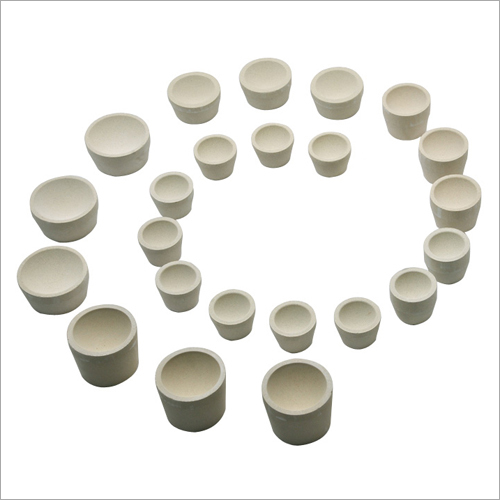
Tell us about your requirement

Price:
Quantity
Select Unit
- 50
- 100
- 200
- 250
- 500
- 1000+
Additional detail
Mobile number
Email

More Products in Magnesia Cupels Category
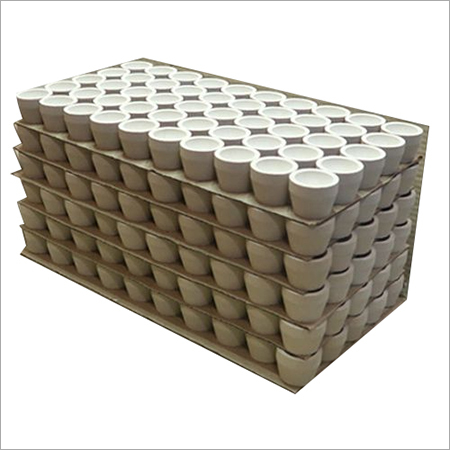
Magnesia Refractory Bullion Cupels
Minimum Order Quantity : 5 Metric Tons
Strength : High mechanical strength
Dimensional Stability : Other, Excellent under high temperature
Chemical Composition : MgO (Magnesia) >97%, trace SiO2, CaO
Application : Precious metal assay, Bullion Refining, Laboratory Testing
Color : White to offwhite
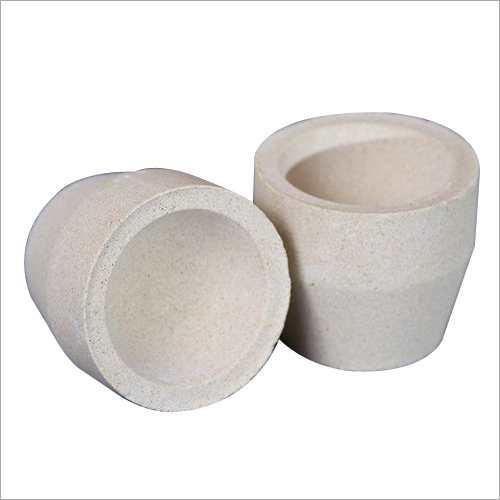
7AS Magnesia Cupels
Minimum Order Quantity : 5 Metric Tons
Strength : High crushing and thermal strength
Dimensional Stability : Other, Excellent under thermal cycling
Chemical Composition : MgO > 95%
Application : Precious metal assay gold and silver refining
Color : Light Grey to Off White
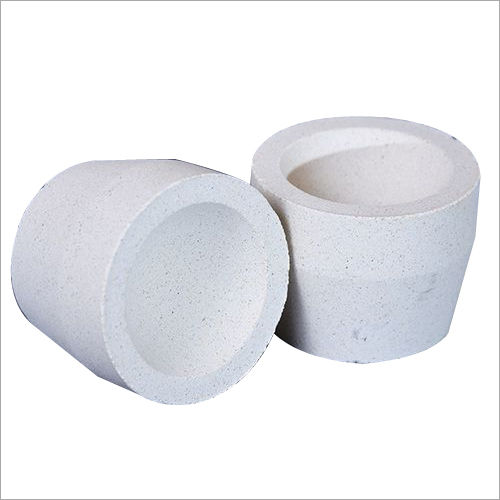
8AM Magnesia Cupels
Minimum Order Quantity : 5 Metric Tons
Strength : High mechanical strength for laboratory use
Dimensional Stability : Other, Superior dimensional stability at operating temperatures
Chemical Composition : High purity MgO, minor CaO and SiO traces
Application : Assaying and refining of precious metals, gold and silver testing
Color : White/Grey
8C Magnesia Cupels
Minimum Order Quantity : 5 Metric Tons
Strength : High mechanical strength, suitable for hightemperature cupellation
Dimensional Stability : Other, Excellent, maintains shape at assay temperatures
Chemical Composition : MgO > 98%
Application : Precious metal assay, gold and silver refining laboratories
Color : White to light grey

 Send Inquiry
252/28, N.M Arcade, 1st Floor, Opp. ARRS Multiplex, Meyyanur By- Pass Road,Salem - 636009, Tamil Nadu, India

Mr Prasad Shah
(Proprietor)
Mobile :08045476828
 Send Inquiry
 Send SMS
Developed and Managed by Infocom Network Private Limited.
